

Introduction
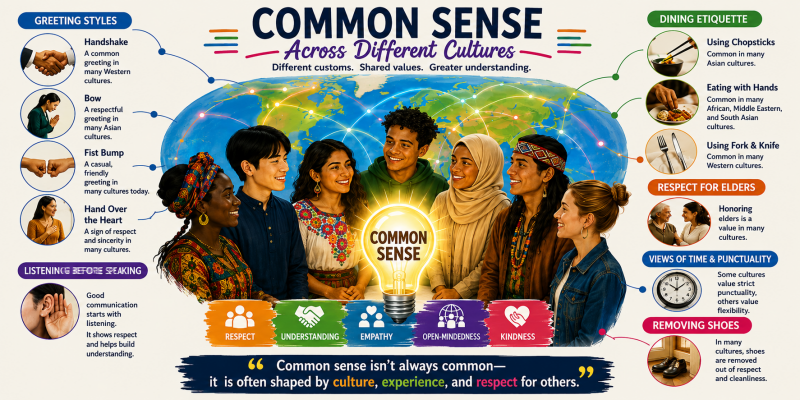
Common sense often refers to the basic level of practical knowledge and judgment that is shared by a group of people. However, what constitutes “common” varies widely across different contexts. This divergence can be traced back to a multitude of factors, including culture, upbringing, education, and individual experiences. In this article, we will explore how these elements shape our understanding of common sense and why it is not universal.
The Role of Culture
Culture is one of the most significant influences on our perception of common sense. It encompasses the beliefs, values, practices, and norms of a group. For instance, in collectivist societies, common sense may lean toward prioritizing community well-being over individual desires, while in individualistic cultures, the opposite may be true. Such cultural frameworks shape how people interpret situations, make decisions, and interact with one another.
Upbringing and Family Influence
Family plays a crucial role in shaping our understanding of common sense. From a young age, children absorb lessons from parents, siblings, and relatives. These lessons create a foundation for what is deemed acceptable behavior and thought patterns. Variances in parenting styles, values, and expectations can lead to significantly different interpretations of common sense among siblings or peers from the same community.
Education and Knowledge
Formal and informal education further refines our understanding of common sense. Education systems vary dramatically across the globe, affecting what is taught and how critical thinking is cultivated. Those exposed to a broad curriculum that encourages questioning and analysis may develop different perspectives than those who experience a more rigid educational framework. Moreover, access to resources, literature, and educators shape the breadth of knowledge that informs our judgment.
Personal Experiences
Individual experiences are perhaps the most subjective aspect influencing common sense. Life experiences, whether traumatic, joyous, or mundane, contribute to our worldview. For example, someone who has traveled extensively may have a broader perspective on social norms than someone who has stayed within their community. Personal encounters shape our beliefs and potential biases, leading to unique interpretations of situations that others might view differently.
The Danger of Assumed Universality
Assuming that one’s view of common sense applies universally can lead to misunderstandings and conflicts, especially in multicultural settings. For instance, what might be seen as respectful in one culture could be interpreted as rude in another. This misunderstanding underscores the importance of empathy and open-mindedness. Recognizing and acknowledging the diverse interpretations of common sense fosters more effective communication and can help bridge cultural divides.
Conclusion
Common sense is not a one-size-fits-all concept. It is a complex tapestry woven from the threads of culture, upbringing, education, and individual experiences. Understanding this diversity is crucial in our increasingly interconnected world. By appreciating the different forms of common sense, we can enhance our interactions, minimize misunderstandings, and foster a more inclusive society.
References
- Baumrind, D. (1991). "The Influence of Parenting Style on Adolescent Competence and Substance Use." Journal of Early Adolescence, 11(1), 56-95.
- Bransford, J. D., Brown, A. L., & Cocking, R. R. (2000). How People Learn: Brain, Mind, Experience, and School. National Academy Press.
- Dweck, C. S. (2006). Mindset: The New Psychology of Success. Random House.
- Hall, E. T. (1976). Beyond Culture. Anchor Books.
- Hofstede, G. (1980). Culture's Consequences: International Differences in Work-Related Values. Sage Publications.
- McLanahan, S., & Sandefur, G. (1994). Growing Up with a Single Parent: What Hurts, What Helps. Harvard University Press.
- Neisser, U. (1976). Cognitive Psychology. Appleton-Century-Crofts.
- Schwartz, S. H. (1994). "Beyond Individualism/Collectivism: New Cultural Dimensions of Values." Intrasocietal Differences in Values, 25-37.
- Stets, J. E., & Burke, P. J. (2000). "Identity Theory and Social Identity Theory." Social Psychology Quarterly, 63(3), 224-237.
- Trompenaars, F., & Hampden-Turner, C. (1998). Riding the Waves of Culture: Understanding Diversity in Global Business. Nicholas Brealey Publishing.
Scriptural Reference:
- Proverbs 18:2 (NIV): "Fools find no pleasure in understanding but delight in airing their own opinions."
#CommonSense #CulturalAwareness #Diversity #Inclusion #Leadership #Communication #EmotionalIntelligence #GlobalMindset #Respect #Learning #ProfessionalDevelopment #ThePointDMV #GiftOfDiscernment
Add comment
Comments